MEASUREMENTS:
Height: 9.5 cm; Width: 18.5 cm; Depth: 18.8 cm; Weight: 2.089 kg
Item :
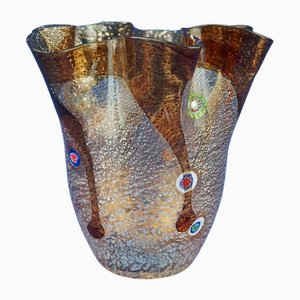
Magnificent Murano milk glass centerpiece bowl with an organic design, a masterpiece entirely modeled freehand in the furnace and featuring a unique spiral pinwheel decoration in thick reddish-brown glass paste, an anonymous piece created around the mid-20th century. This extraordinary and imposing handkerchief-shaped vase-sculpture, a superb expression of high-period Venetian glass art, is a work of exceptional collector's value, attributable to the historic avant-garde production of the Murano glassworks. Its stylistic and material elements are consistent with the design mastery of Barovier & Toso or the Aureliano Toso atelier, and it dates to the mid-20th century (circa 1950–1965). Although the work lacks an engraved signature (a common feature among many large-scale, display pieces crafted in the furnace during those years), the exceptional thickness of the milky glass, its specific weight of over 2 kg, and the exquisite iridescent metallic lustre finish applied to the decorative girandola allow us to trace the stylistic and manufacturing origins back to the most renowned Murano glassworks of the mid-20th century, with a clear reference to the contemporary experiments of masters such as Ercole Barovier and Dino Martens. The exceptional nature of the piece, which extends over generous proportions of 18.9 by 18.5 centimeters and stands 9.5 centimeters tall, is underscored by a massive structure of genuine milky glass weighing over 2 kg. Its milky, vitreous density is revealed in person even more than in photographs, in all its magnificent material opacity. Modeled entirely freehand in the furnace, the upper rim unfolds into a complex crown of pointed edges and deep, organically sculptural undulations, while the white glass body is wrapped around the back in a bold, geometric pinwheel structure: three spiraling filaments of thick, reddish-brown paste emanate from the exact center of the base and radiate outward, treated with metallic vapors to achieve a shimmering pearlescent iridescence that shifts from purple to bronze. The true distinguishing feature of this superb milk glass work lies in the virtuosic craftsmanship of the upper rim. The wavy, crown-like profile was entirely modeled "hot" using precise scissor cuts performed by the master glassmaker. Each individual ridge was then meticulously hand-grinded and cold-polished. The result is a flawless perimeter texture: the edges are plump, perfectly smooth, and pleasantly rounded to the touch, free of any tool marks or seams. A high-quality finish that demonstrates the exceptional craftsmanship of the most celebrated Murano glassworks of the 1950s. Finally, the spectacular iridescent metal-vapor finish not only decorates the glass filaments, but delicately envelops the entire surface of the rare milky white background glass, as clearly demonstrated by the iridescent light reflections captured in the photographs, revealing magnificent pearly and mother-of-pearl nuances at every angle. Finally, the presence of the characteristic pontello, finely ground on the wheel under the cushion base, and the subtle internal micro-boiling rule out any industrial production, testifying to the authenticity of an entirely handcrafted piece at extremely high temperatures. In ancient Murano glassmaking, the pontello is the iron rod used by the master glassmaker to support and rotate the still-incandescent piece during the delicate final modeling phases in the furnace; The circular mark visible on the bottom represents the scar left by this tool when the piece was detached, an imprint certifying its authentic freehand execution.
Information on the artist and/or manufacturer:
The tradition of Murano milk glass, historically born in the 15th century to imitate the early secrets of Chinese porcelain and successfully revived in the 20th century by the greatest avant-garde glassmakers, represents one of the most cultured and fascinating chapters in the history of the decorative arts. The historic furnaces of the early 20th century, collaborating with architects and painters such as Dino Martens and Ercole Barovier, transformed this opaque, milky glass into a sculptural surface, enriching it with asymmetrical inclusions of colored paste and revolutionary iridescent mineral salt patinas. The creations resulting from these challenging thermal experiments redefined the aesthetic of Midcentury Modern design, triumphing at the Venice Biennale and conquering the greatest private collections overseas. Today, the rare, monumental examples in heavy, iridescent lattimo, crafted freehand, are the subject of ongoing research by museums around the world and are permanently included in prestigious global institutions, including the collections of the Murano Glass Museum in Venice, the Corning Museum of Glass in New York, and the Musée des Arts Décoratifs in Paris.










Get in Touch
Make An Offer
We noticed you are new to Pamono!
Please accept the Terms & Conditions and Privacy Policy
Get in Touch
Make An Offer
Almost There!
To follow your conversation on the platform, please complete the registration. To proceed with your offer on the platform, please complete the registration.Successful
Thanks for your inquiry, someone from our team will be in touch shortly
If you are a Design Professional, please apply here to get the benefits of the Pamono Trade Program